

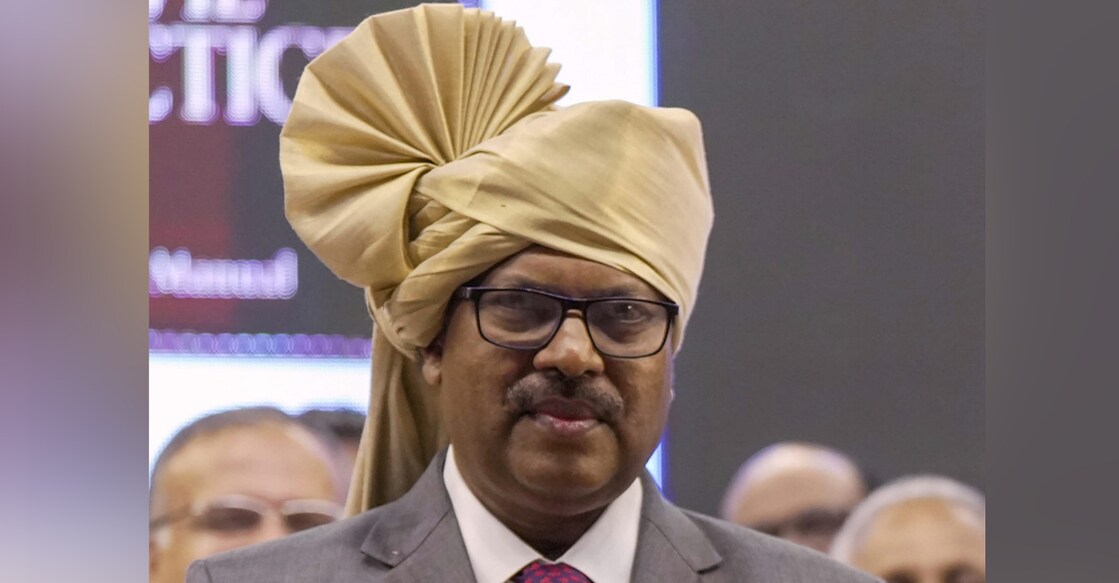
Justice Bhushan Gavai to succeed CJI Sanjiv Khanna; oath taking on May 14
Mail This Article
New Delhi: Chief Justice of India Sanjiv Khanna has recommended Justice Bhushan Ramkrishna Gavai to the Centre as his successor. Currently the second senior-most judge in the Supreme Court, Justice Gavai is set to take charge as the 52nd Chief Justice of India on May 14, following CJI Khanna’s retirement on May 13, reported PTI.
Justice Gavai was elevated to the Supreme Court on May 24, 2019. As the incoming Chief Justice, he will serve a term of over six months before his scheduled retirement on November 23, 2025. CJI Khanna, who took oath as the 51st Chief Justice on November 11 last year, has officially recommended his successor’s name to the Union Law Ministry. Supreme Court judges retire upon attaining the age of 65.
Born on November 24, 1960, in Amravati, Justice Gavai began his judicial career when he was appointed an additional judge of the Bombay High Court on November 14, 2003. He was confirmed as a permanent judge on November 12, 2005.
Throughout his tenure in the apex court, Justice Gavai has served on several Constitution benches that delivered significant rulings. He was among the five judges who, in December 2023, unanimously upheld the Centre’s move to revoke Article 370, which granted special status to the erstwhile state of Jammu and Kashmir.
He also sat on a five-judge bench that struck down the electoral bonds scheme meant for political funding. Another key decision he contributed to was the 4:1 majority verdict by a five-judge bench that endorsed the Centre’s 2016 demonetisation of Rs 500 and Rs 1,000 currency notes.
Justice Gavai was part of a seven-judge bench which ruled, by a 6:1 majority, that states have the constitutional authority to create sub-categories within the Scheduled Castes to ensure reservation benefits reach the most disadvantaged among them.
In another landmark ruling, he was on a bench that held that arbitration clauses in unstamped or insufficiently stamped agreements are valid, as the defect is curable and does not render the contract void.
Heading a bench, Justice Gavai also issued pan-India guidelines stating that “no property should be demolished without a prior show-cause notice” and that affected parties must be given a 15-day period to respond. Presently, he is presiding over matters concerning environmental issues, including forest and wildlife protection and tree conservation.
Justice Gavai began practising law on March 16, 1985. He served as standing counsel for the Municipal Corporation of Nagpur, Amravati Municipal Corporation, and Amravati University. From August 1992 to July 1993, he worked as an assistant government pleader and additional public prosecutor at the Bombay High Court’s Nagpur bench. He later became the government pleader and public prosecutor for the Nagpur bench on January 17, 2000.
As per the Memorandum of Procedure (MoP), which governs the appointment and elevation of judges, the Union Law Minister formally writes to the incumbent CJI seeking the name of the successor. The MoP stipulates that the senior-most judge of the Supreme Court is usually considered for the top post, and the outgoing CJI’s recommendation must be obtained “at an appropriate time.”
 Add as a preferred source on Google