



Techspectations concludes with call to democratise AI for a future-ready India by 2030
Mail This Article


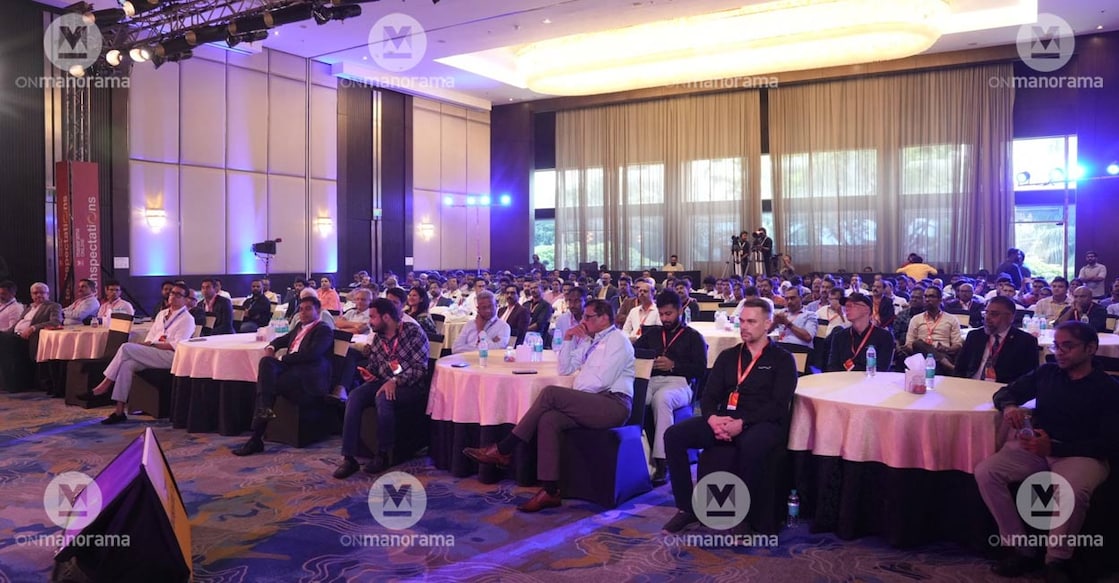
ManoramaOnline’s flagship digital summit Techspectations concluded on Friday with a strong call to democratise artificial intelligence and prepare India’s workforce and businesses for the fast-approaching realities of 2030. Held under the theme ‘Crystal Balling 2030’, the sixth edition brought together leaders from technology, startups, media and cinema to map the opportunities and risks shaping the next digital decade.
From Amazon Web Services’ $35 billion India investment roadmap to warnings about AI-led job disruption and the growing credibility crisis in the social media era, the discussions at Hotel Crowne Plaza, Kochi repeatedly underscored the need for responsible innovation, future-ready skills and wider access to emerging technologies.
Sandeep Dutta, President of Amazon Web Services for India and South Asia, stressed that India’s AI success will depend on democratising access to technology. Meanwhile, Kerala Startup Mission CEO Anoop Ambika cautioned that new energy systems, data centre expansion and automation could significantly reshape the job market, with skilled electricians and hardware workers potentially earning more than some white-collar professionals. The summit also spotlighted the evolving media ecosystem, with journalist Faye D’Souza warning that platforms such as Facebook are still failing to adequately flag misinformation.

Setting the tone for the summit, Mariam Mammen Mathew, CEO of ManoramaOnline, said the initiative encourages participants to think like futurists amid rapid global change. “For a moment, we invite ourselves to step into the role of futurists, to look beyond the noise of the present and attempt a disciplined glance at the future. In a world shaped by exponential growth in AI, volatile geopolitics, platform disruptions and an AI-accelerated global economy, even predicting the next quarter feels bold,” she said.
Emphasising the organisation’s long digital journey, she added: “Uncertainty is not paralysis. It is a signal. At ManoramaOnline, nearly three decades of digital journalism have taught us that disruption is not an interruption; it is a turning point. From the upheaval of COVID-19 to the ongoing AI revolution, every wave of change has forced reinvention.”

Democratise access to technology: Sandeep Dutta
Delivering the keynote address titled “Re-architecting the future: How cloud, AI and intelligent infrastructure will shape India by 2030,” Sandeep Dutta, President of Amazon Web Services (AWS) for India and South Asia, stressed that India’s success in artificial intelligence will depend on democratising access to technology.
He said AWS would deepen its “purpose-led” engagement in India, announcing plans to invest $35 billion (about ₹2.9 lakh crore) in the country between now and 2030. The investment, he noted, will focus largely on skilling and education and comes in addition to the $40 billion already spent to help digitise millions of small businesses.
Dutta underlined the role of digital public infrastructure in India’s tech growth, citing Aadhaar and UPI as global-scale examples. He also pointed to platforms such as Poshan Tracker, PM-JAY, DigiLocker and Digi Yatra as evidence of how complex technology can be deployed to deliver grassroots impact at scale.
“Our regions in Mumbai and Hyderabad are ready to propel the next level of digital transformation in India,” he said, adding that building an AI-skilled, tech-enabled workforce would be central to the country’s future competitiveness. Since 2016, AWS has trained more than 6.2 million individuals in cloud and related skills, he noted.
'Electrician could earn more than engineer'
The panel “Catalysts 2030: India’s Next Wave of Scalable Tech Innovators” highlighted the global growth potential of Indian tech ventures while urging businesses to brace for rapid AI-driven shifts. Kerala Startup Mission CEO Anoop Ambika, citing reports of Jack Dorsey–co-founded Block cutting about 4,000 jobs, stressed the need for preparedness rather than alarm. He said emerging energy systems and data centre expansion could boost demand for skilled hardware workers, with Kerala’s digital literacy giving it an edge.
-
1 HOUR 56 MINUTES AGO
Director Ranjith sent to SIT custody till Monday in sexual assault case

InfinyAI Labs CEO Anuraj Ennai noted that while generative AI dominates today, physical AI could take centre stage by 2030, alongside challenges such as rising energy use and material shortages. Chiranjiv Founder and CEO Hemant Jain predicted major AI-led changes in healthcare within five years.
GIC Private Limited Vice President Ashish Agarwal cautioned against AI hype, saying real products will still drive value. Eight Times Eight Co-Founder Abhijith M emphasised AI will support, not replace, education, as parents continue to value human teachers. The session was moderated by Felix Josemon of ConversationAB and KPH.
How journalists & influencers differ
In the session titled “News, Creators & the New Social Universe,” journalist and Beatroot News founder Faye D’Souza joined social media personality Dr Anil Abraham and Onmanorama Producer Joshua Eugine to examine how the digital ecosystem is reshaping journalism and creator responsibility.
D’Souza warned that the race for “digital TRPs” and algorithm-driven feeds is blurring the line between journalism and influencer content, stressing the urgent need to restore the dignity of news.
Highlighting accountability as the key differentiator, D’Souza said her team issues apologies whenever errors occur. She also spoke of the dangers of platforms failing to flag misinformation. "YouTube offers mechanisms to correct and report misinformation, but such options are more limited on Facebook. Even my mother once fell for false information on Facebook," she said.
Dr Anil Abraham compared today’s social media discourse to the traditional Kerala tea shop conversation, but warned that algorithmic feeds often push audiences into echo chambers where aggressive opinions are rewarded with more views. He emphasised that creators must remain authentic and responsible, noting that audience trust ultimately depends on consistency between what creators say and what they do.
Why are enterprises still hesitant to adopt AI?
Enterprises remain cautious about adopting AI despite its transformative potential, Tech Mahindra’s Kunal Purohit said at the Visionary Address on 'The Vibe Coding Era: How India's Software Services Ecosystem is Reinventing Itself'. Purohit explained that AI is reshaping software roles from traditional coders to “co-creators” and now “orchestrators”, with engineers focusing more on systems thinking and prompt engineering while AI handles routine coding. Tech Mahindra already has about 30,000 employees working with nearly 1,000 AI agents.
However, adoption is slowing due to key concerns. Enterprises must ground AI in real business context, ensure more deterministic and reliable outputs, strengthen security and authentication, maintain high-quality data, and manage organisational change. Purohit noted that companies are still grappling with these challenges and are not fully ready for the shift.
AI reshaping retail landscape
In another session, experts examined how artificial intelligence is set to transform India’s retail landscape by 2030, with the industry moving from search-driven shopping to predictive, AI-led discovery. Moderated by Mohan Thomas of HiFx and Bhashamitra.ai, the panel said brands must shift focus from chasing clicks to delivering outcomes by deeply understanding customer context and behaviour.
Speakers including Aaron Rigby of Taboola, Sarita Priyadarshini of Snowflake, Narasimha Rao of MoEngage and Ayshwarya Ramakrishnan of Microsoft stressed that hyper-personalisation, vernacular AI and real-time contextual marketing will define the next phase of commerce. They also highlighted the growing importance of enterprise-grade AI governance and data privacy as retailers adopt agentic AI systems, noting that AI-first brands could scale to ₹100 crore revenues far faster than before.
'Human-made content more valuable than AI': Pisharody
At the session 'Fame to Fandom: How Movies, Stars & Screens are evolving towards 2030', actors Jayasurya and Ramesh Pisharody said AI can enhance filmmaking workflows but cannot replace the emotional depth that human performers bring to cinema. Jayasurya noted AI is most effective in pre-production tasks such as art direction, costumes and visual planning, where it dramatically reduces time, but stressed that the creative spark still comes from people. Pisharody added that originality builds audience trust and that hand-crafted art will always hold greater value than AI-generated work.
Both actors emphasised that AI may assist visualisation and speed but cannot truly feel or express diverse human emotions. Jayasurya warned of potential misuse of AI and pointed out the continuing high costs of VFX, while also highlighting the imagination actors need when performing in green-screen-heavy films like Kathanar. They concluded that while AI will increasingly support the industry, authentic human performance will remain at the heart of cinema, especially for discerning Malayalam audiences.

'Trust & responsibility key to AI-based platforms'
During the session 'What Changes When AI Becomes the Platform', Manmeet Dhody, Vice President of Engineering at Adobe, emphasised that trust and responsibility are critical when building AI-based platforms. He noted that customers demand accuracy and reliability, and a single error can erode confidence. Highlighting Adobe’s approach, he said the engineering team works closely with clients to ensure the platform performs correctly every time.
Dhody showcased the Adobe Experience Platform Agent Orchestrator, which coordinates expert AI agents to handle complex decision-making, multi-step workflows, and contextual problem-solving. He stressed data sovereignty, explaining that enterprises require AI to operate solely on their own data. Using multiple agents, the platform achieves high scalability, delivers precise insights, and enables data-driven decision-making while maintaining alignment with brand objectives.
‘AI won’t kill creativity, but lazy thinking will’
At the final session of ManoramaOnline Techspectations 2026, Aditya Kanthy, President and MD of Omnicom Advertising India, stressed that AI will not replace creativity, but lazy thinking will. Speaking alongside Boby Paul of ManoramaOnline, he debunked myths around AI in advertising, arguing that while automation can handle repetitive tasks, the human touch remains essential for effective brand storytelling. Kanthy urged marketers to adopt a hybrid approach, blending data-driven insights with intuition to connect meaningfully with audiences, warning that abandoning creativity in favour of efficiency is a mistake.
Kanthy also highlighted India’s growing role as a global hub for strategic and creative talent, noting that AI empowers small businesses and regional creators to reach audiences in local languages. He pointed out that India’s robust digital and payments infrastructure allows a complete consumer journey, positioning the country as a leader in creative and strategic campaigns for both domestic and international markets.
 Add as a preferred source on Google